
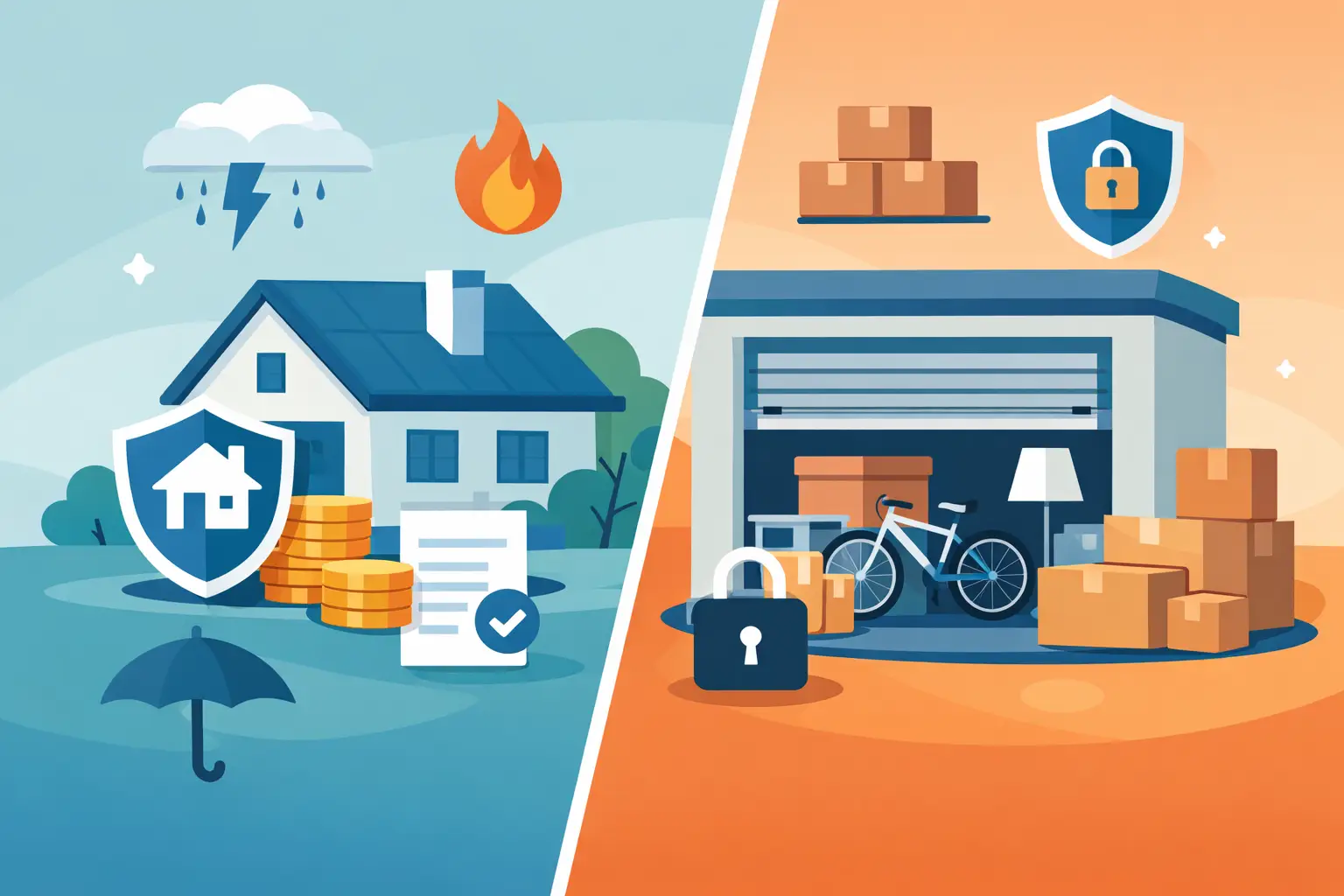
You packed the unit, locked the door, and assumed your stuff was covered. That is where a lot of people get burned. When comparing homeowners insurance vs storage coverage, the real question is not whether you have some protection. It is whether that protection actually holds up when your belongings are sitting off-site, inside a storage unit, or inside a mobile container exposed to weather, theft, and real-world damage.
A lot of storage customers assume their homeowners policy covers everything in storage. Some do provide limited off-premises protection. But limited is the key word. Coverage often comes with lower caps, tighter rules, and exclusions that show up at the worst possible time. On the other side, many storage-facility plans are not full insurance policies at all. They may be cheap-looking at checkout, but they can be narrow, capped, and full of restrictions.
That is why this comparison matters. If you are storing furniture during a move, keeping family items in a unit while renovating, or relying on a PODS-style container during a long transition, guessing is expensive.
Homeowners insurance vs storage coverage: what is the difference?
Homeowners insurance is designed first and foremost to protect your home, attached structures, and personal property. Personal belongings stored away from your house may still be covered, but usually under an off-premises personal property provision. In many policies, that amount is lower than what you get for belongings kept at home.
For example, if your homeowners policy covers personal property up to a certain amount, off-premises coverage may only pay a fraction of that. That sounds fine until you add up what is actually in storage. A few bedroom sets, electronics, tools, seasonal decor, and family keepsakes can hit that cap fast.
Storage coverage is built specifically for belongings kept in a storage unit or mobile storage container. Instead of treating storage as an afterthought, it treats stored property as the main risk. That matters because the claims people file for storage losses are not theoretical. They involve break-ins, water damage, severe weather, fire, and other hazards that can wipe out a unit in one event.
The biggest difference is focus. Homeowners insurance protects your life at home. Storage coverage protects what is sitting somewhere else, often for weeks or months, with risks that look very different from the ones inside your house.
Why homeowners coverage can fall short
The problem with relying on homeowners insurance for stored belongings is not that it never works. It is that it may work only partially.
First, the limit may be too low. Off-premises property coverage is often restricted to a percentage of your total personal property limit. If your stored belongings are worth more than that sublimit, you are already underinsured.
Second, deductibles can make smaller claims pointless. If your homeowners deductible is $1,000 or $2,500, a modest storage loss may not be worth filing. You are paying for protection that may not be practical when something actually happens.
Third, some types of damage may be excluded or narrower than people expect. Water-related damage is where confusion gets expensive. People hear the word water and assume all water events are treated the same. They are not. Flooding, storm-driven water, seepage, and other causes can be treated very differently depending on the policy.
Then there is the claims history issue. Filing a claim on your homeowners policy can affect more than just the items in storage. It can impact your main home policy record. For some people, that is reason enough to keep storage risk separate.
What storage-facility protection plans often do not tell you
A storage operator may offer a protection plan at move-in. It is fast, it is convenient, and it gets added to your bill. That does not automatically make it good coverage.
Many of these plans are not true insurance policies. They can be limited contractual protection programs with narrower terms than people expect. That can mean lower limits, more exclusions, and less flexibility when a claim is filed.
This is where consumers need to slow down. A low monthly add-on can end up being overpriced for what it actually covers. Some plans leave out major weather events. Some do not match the value of what customers really have in storage. Some are built more to satisfy a facility requirement than to fully protect your property.
That is the difference between checking a box and buying real protection.
Homeowners insurance vs storage coverage for mobile storage
Mobile storage changes the risk even more. A container sitting in a driveway, on a job site, in transit, or parked at a storage yard is exposed differently than property inside your home. It may face theft risk, weather exposure, transportation-related handling, and flood-prone placement.
This is where homeowners insurance vs storage coverage becomes even less of a close call. Standard homeowners coverage was not built around mobile storage realities. If you are using PODS, PackRat, Mobile Mini, Clutter, valet storage, or another portable storage option, you need to know whether your current policy actually follows those belongings in a meaningful way.
A policy built for stored contents is usually the better fit because it addresses the exact use case. That means clearer coverage for property that is off-site and not sitting safely inside your residence.
What to look for in real storage coverage
If you are shopping smart, do not just ask whether a plan exists. Ask what kind of protection it actually gives you.
Start with coverage limits. Make sure the amount available reflects what is really inside the unit or container. Underinsuring stored belongings is common because people underestimate replacement cost. Mattresses, sofas, appliances, bicycles, business tools, and packed boxes add up quickly.
Next, look at covered causes of loss. This is where strong storage insurance separates itself from weak facility plans. Broader protection matters. So does coverage for losses people often overlook, including flood and named storms.
Then look at the source of the policy. Real insurance from an A-rated underwriter is not the same thing as a thin in-house protection program. If you want confidence at claim time, that distinction matters.
Finally, compare price against value, not just the monthly number. Paying more for less coverage is not convenience. It is a bad deal.
The smarter question is not “am I covered?”
The smarter question is, “Covered for what, how much, and under which policy rules?”
That is where people separate smart protection from false confidence. If your homeowners policy only gives partial off-premises coverage, and the storage facility sells a limited plan with major gaps, neither option may be good enough on its own.
For many storage customers, a dedicated storage contents policy is the cleaner answer. It is simpler to understand, easier to match to the value of your stored belongings, and more aligned with the actual risks of self-storage and mobile storage.
That is exactly why companies like SnapNsure focus on real storage insurance instead of watered-down protection plans. The appeal is straightforward: stronger coverage, higher available limits, meaningful protection for mobile storage, and monthly pricing that can save customers significantly compared with storage-operator offerings.
Who should pay closest attention
If you are between homes, renovating, downsizing, deploying, sending a student between semesters, or storing property during a move, this is not a technical insurance debate. It is a practical money decision.
These are the moments when people tend to rely on storage longer than expected. A short-term unit turns into six months. A portable container stays loaded through an entire project. The more time your belongings spend off-site, the less sense it makes to rely on vague assumptions.
And if you are storing items with real replacement cost, a weak plan can become obvious only after a loss. By then, it is too late to fix.
How to choose without overpaying
Start by checking your homeowners policy and asking specifically about off-premises personal property limits, exclusions, deductibles, and whether mobile storage is treated differently. Do not settle for a general answer.
Then compare that with any storage-facility plan being offered. Ask whether it is actual insurance, what losses are covered, what is excluded, and what the maximum payout is per unit.
If the answers feel fuzzy, that is a warning sign. Insurance should be clear before the claim, not only after the damage is done.
A dedicated storage policy usually makes the most sense when you want broader protection, higher limits, cleaner terms, and a price that does not punish you for using storage. The best setup depends on your situation, but one thing is consistent: the cheapest-looking option is not always the one that protects you best.
Before you keep paying for a plan that may not do much when it counts, make sure your coverage matches your reality. Your belongings do not care whether the loss happened at home or inside a storage unit. They still need real protection.